


🎧Introduction: If I Could Reinvent Myself, You Can Too
Aviation Systems Technician. Sounds a bit intimidating, right? Like something only an electrical engineer would understand? Don’t be fooled. This is a hands-on job that thousands of people step into every year. Moreover, they come from a wide range of backgrounds.
I’ve written all the articles in this series for all of you who are looking for a new job. Maybe you’ve been laid off from a white-collar job. Perhaps you’ve worked in retail, logistics, or support roles for years, faithfully. Don’t despair. Your experience and skills will transfer to the aviation sector more easily than you think.
I’ve been there. Done that. It’s not easy. However, thanks to the AI tools you have available, you can explore jobs and find matches with your experience and skillset in a nanosecond. Good luck!
Listen to this article now. Audio powered by LM Notebook.
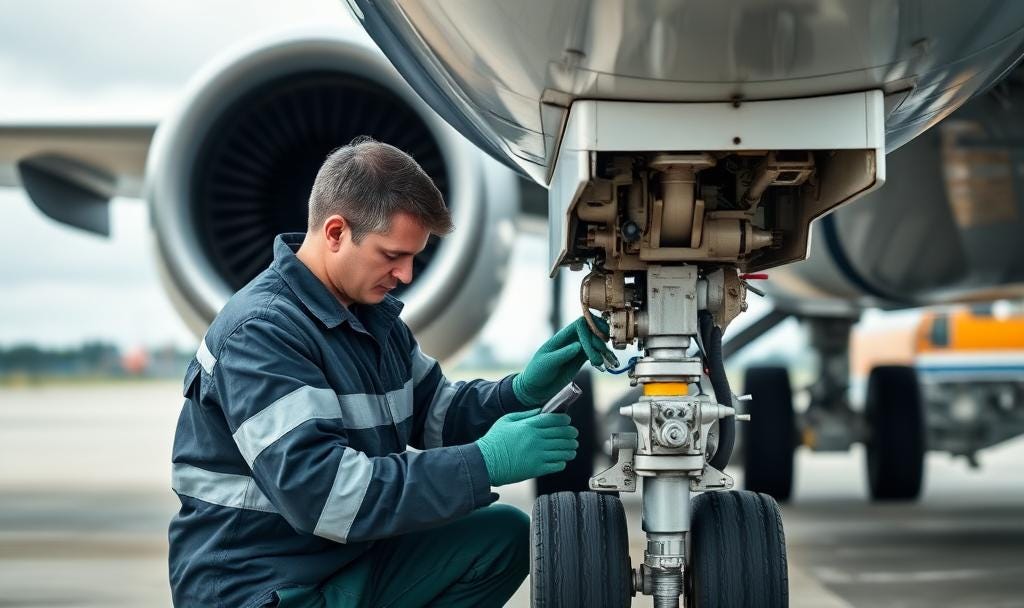
🧳What Does an Aviation Systems Technician Do?
Aviation systems technicians are the individuals responsible for keeping planes ready to fly.
They:
Maintain and repair airframe structures, hydraulics, and flight control systems.
Service and inspect propulsion systems, including turboprops and jet engines.
Diagnose and repair electrical systems, batteries, wiring, and cabin electronics.
Support integrated systems such as pressurization, de-icing, fuel delivery, and landing gear.
This is precision work. It's done with tools in one hand and a checklist in the other. If something breaks on an aircraft, it doesn’t get fixed with duct tape. It is fixed correctly, safely, and in accordance with strict regulations and protocols. Furthermore, everything is documented.
Who’s Making the Career Switch and Why?
✅ From Auto Parts to Aircraft Parts
If you’ve worked in an auto parts store and know what a solenoid is, how to read a diagnostic scanner, or how to find the right part for a customer’s needs, you already understand how mechanical systems work. Your experience can translate smoothly into aviation. You already know how to match parts to problems. Now you’ll learn how to do it for an aircraft.
✅ From Aisles to Aircraft
Perhaps you stocked shelves at a supermarket or a big box store. If you know how to handle tight deadlines, to do physical work, and to meet precise restocking schedules, you already have the discipline this job requires.
An aviation systems technician needs that same focus and speed. Loading parts and tools, tracking inventory, and adhering to safety protocols are essential components of the job.
✅ From the Conference Room to the Cockpit Bay
Were you a project manager, scheduler, or analyst who got laid off during a restructuring? The same systems thinking you used to manage timelines and resources can apply directly to aircraft maintenance.
Many displaced white-collar professionals are discovering how fulfilling it is to work with their hands again, solving physical problems rather than just digital ones. Perhaps you won’t become a licensed tech. But you might find a path into quality control, compliance, or even training.
Here are some of the related jobs according to the Government of Canada’s Job Bank:
✅ From the Back Office to Hangar Support
This field also suits people who’ve written manuals, created purchase orders, or supported IT systems. If you have experience with inventory control, purchasing software, or technical documentation, you may start out supporting technicians and eventually transition to the more technical aspects of the work.
You already understand the importance of accuracy and deadlines. Compliance is the watchword in aircraft maintenance. Your previous work experience will serve you well in this demanding field.
✅ From TikTok to Toolkits
Aviation systems technician jobs aren’t just for men and women who have been employed for a few years. The field also works for Gen Zers. Maybe you’ve never turned a wrench, but if you’ve built a gaming PC, set up smart home devices, or wired LED lights onto your bike, you’ve already demonstrated the kind of curiosity and tech fluency that the aviation industry needs.
Aircraft diagnostics are digital. Tablets, apps, checklists, and data readouts are second nature to you. Add a bit of training, and you’ll be ready to go.
This video explains what aviation systems technicians do and their typical earnings.
🛩️How to Get Trained
While you don’t need a four-year degree for most of these jobs, you will need to earn a specific certification depending on the country in which you plan to work.. Most aviation technicians begin their careers with a two-year program at a technical school or community college.
In the United States, look for FAA-certified Part 147 schools
In Canada, look for Transport Canada-approved AME training programs
These courses usually take 18 to 24 months and may include co-op placements or apprenticeships
Many schools offer night or weekend options for adults changing careers
Scholarships, military benefits, and grants may be available
You can often begin working in entry-level roles while completing your training.
🪖Licensing and Certification
To work independently, most technicians earn:
In the U.S.: an FAA A&P License (Airframe and Powerplant)
In Canada: an AME License (M1 for small aircraft, M2 for larger ones)
The exams cover written knowledge, oral interviews, and hands-on demonstrations. Many employers will support your certification journey while you gain experience.
What’s the Work Environment Like?
You’ll work both indoors and outdoors.
You’ll be around tools, noise, fuel, and other aircraft operations on the ramp.
Your schedule will include early mornings, evenings, and weekends
You’ll follow checklists, maintain detailed records, and work closely with inspectors and pilots
You’ll use both manual tools and digital diagnostics
You’ll never stop learning because new aircraft models bring new systems and standards
This video reports on the need for aviation systems technicians.
Who’s a Good Fit?
This work is ideal for people who:
Pay attention to detail
Like solving problems
Work well with their hands
Follow strict safety rules
Are punctual
Enjoy teamwork
Are tired of jobs that feel meaningless or unstable
It’s especially great for:
Veterans
Women in trades
Mid-career switchers
Tech-savvy youth
People ready for a new chapter in their careers
What Does It Pay?
Entry-level jobs typically start at $22 to $30 per hour
Licensed and experienced techs often earn $70,000 to $120,000 per year
Some roles include night shift bonuses, union benefits, travel benefits and overtime
Opportunities exist with:
Commercial airlines
Fixed-base operators (FBOs)
Maintenance and repair organizations (MROs)
Government contractors
Aircraft manufacturers
Check out our Jobs Board for links to aviation companies.
Final Thoughts: You Belong Here
Planes will always need people. People with hands, with minds, with focus, with patience. If you’ve been laid off, aged out, or just burned out, aviation might be the career you didn’t know you were looking for.
You don’t need to be a pilot. You don’t need to be an engineer. You just need to be willing to learn, stay curious, and commit to doing the job right.
The runway is wide open.
✈️ Stay curious!
Rob Kennedy
AvGeek in Residence
Editor’s Note: I write the articles on AvGeek in Residence in collaboration with ChatGPT. This wonderful AI tool functions as my research assistant, my editor, and my brainstorming partner. ~ Rob Kennedy