


Enabling passenger deplaning safely.
Today’s story begins with a look at the men and women who operate the jet bridges at airport gates.
Listen to this article now. Audio powered by LM Notebook.
🧳 The Gateway You Never Think About
Most travellers step onto one without a second thought. It’s not quite part of the plane, not quite part of the terminal. It moves, it hums, and it’s just... there. But behind every safe, secure, and precisely aligned jet bridge is a person, an operator, working a job that rarely gets noticed, let alone celebrated.
Today, we’re stepping onto the jet bridge not as passengers, but as observers. And what we’ll find there might surprise you.
🛠️ What Does a Jet Bridge Operator Do?
Jet bridge operators are responsible for one of the most delicate maneuvers in the entire airport experience. They are the folks who bring the jet bridge to the aircraft (and vice versa) without damage, delay, or risk.
Their duties for an arriving jet include:
Operating the jet bridge safely and in coordination with the flight crew and gate agents
Aligning the jet bridge precisely with the aircraft door using visual markers and onboard controls
Conducting safety checks to prevent damage to the aircraft fuselage or door frame
Once the bridge is properly aligned and secured, the operator often knocks on the small window of the aircraft door to signal the cabin crew that it’s safe to open the door. This subtle but standardized action ensures that the door isn’t opened prematurely, protecting both the aircraft and passengers from injury or equipment damage.
In some cases, particularly at smaller airports or with certain carriers, the jet bridge operator is trained to open the aircraft door from the outside using the built-in exterior handles after confirming the plane is fully parked and secure.
Once the aircraft door is opened, the operator may also facilitate access for ramp crews bringing up the gate-checked bags. These are usually placed in an area on the left of the jet bridge so that passengers can retrieve them.
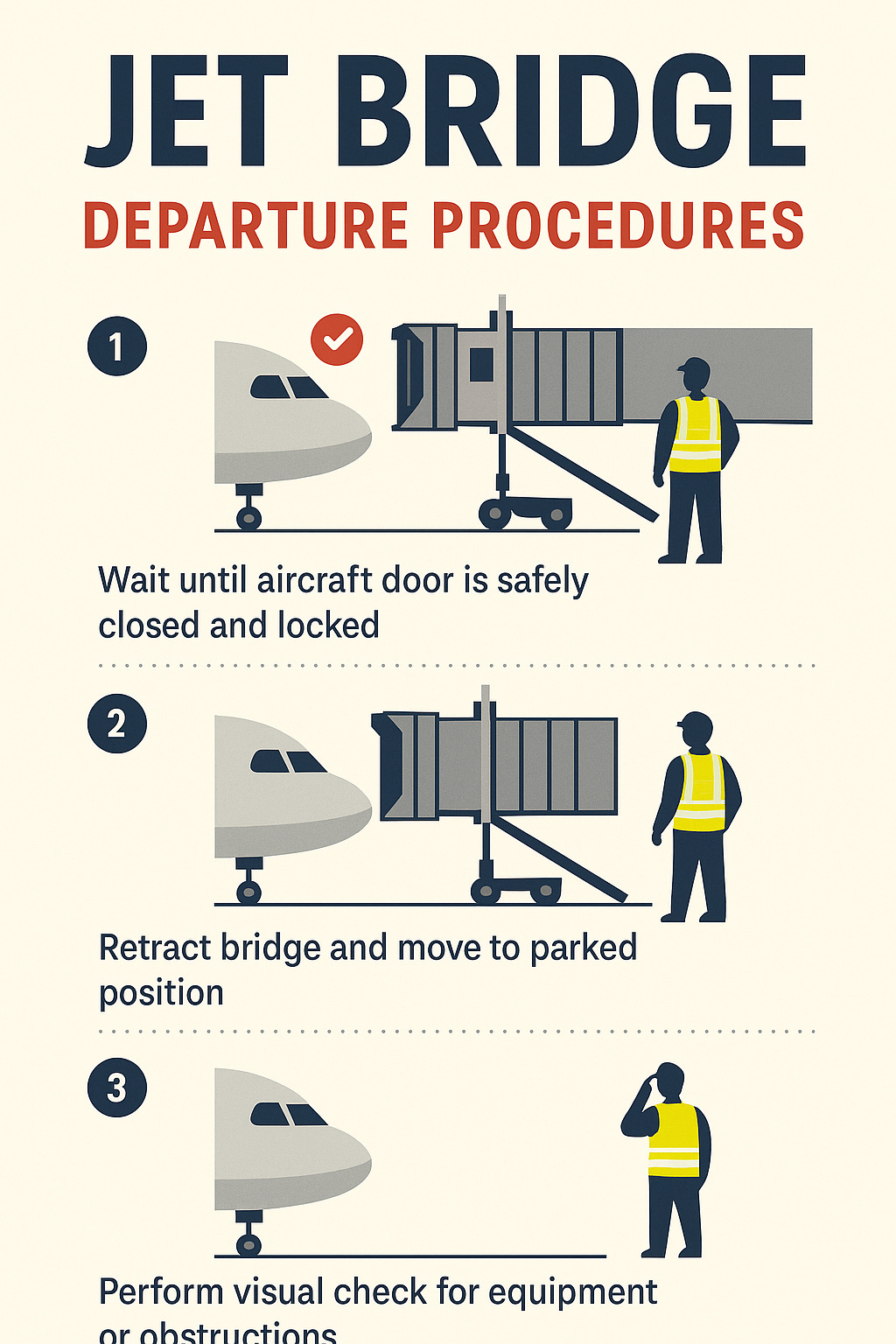
Their duties for a departing jet include:
Coordinating gate-checked items such as:
Strollers
Wheelchairs
Bags too large for overhead bins
At departure, the jet bridge operator waits until the aircraft door has been safely closed and locked before retracting the bridge. Once confirmed, they carefully move it to a parked position, ensuring it’s clear of the aircraft’s path before pushback begins.
The operator performs a final visual check to confirm that no equipment or obstructions remain near the aircraft.
🧑🔧 Who Hires Jet Bridge Operators? What Training Do You Need?
Jet bridge operators are generally employed by firms that specialize in ground handling. I am including the following list of ground handlers so that you can see the extensive range of employment opportunities available in this field. Furthermore, most of the jobs do not require a college degree or certification.
Here are five of the top airport ground handling firms worldwide:
Swissport International Ltd. One of the largest ground handling companies, operating in over 300 airports globally. They provide baggage handling, aircraft servicing, and cargo operations.
Worldwide Flight Services (WFS) A major player in air cargo logistics and ground handling, serving airlines across multiple continents.
Dnata Based in the United Arab Emirates, Dnata offers passenger, ramp, and cargo handling services at airports worldwide.
Menzies Aviation A United Kingdom-based ground handling firm specializing in baggage services, aircraft marshalling, and fueling.
Celebi Aviation Holding A Turkish company providing ground handling, cargo operations, and airport services across Europe and Asia.
🎓Educational Requirements
Requirements typically include:
High school diploma or GED
Must be 18+ with a valid driver's license
Clean background check and drug screening, as per FAA regulations
Ability to work in all weather conditions
Communication skills and mechanical aptitude
Flexibility for shift work, including nights and weekends
Most operators receive on-the-job training, which includes:
Safety procedures, OSHA and FAA compliant
Equipment handling
Emergency disconnection
Radio protocols
Many community colleges also offer aviation maintenance or airport operations programs, where students gain hands-on exposure to ramp equipment and airside protocols. Training on computer-based jet bridge simulators provides trainees with experience before operating a real jet bridge.
🏗️ A Brief History of the Jet Bridge
Before the 1950s, boarding an airplane meant using portable stairs, often in the rain, snow, or baking sun. That changed when Lockheed Martin introduced the first telescoping jet bridge for United Airlines at Chicago’s O’Hare Airport in 1954. Designed to improve comfort and turnaround time, the innovation caught on quickly.
Today’s bridges feature:
Hydraulic or electric drive systems
Climate control for comfort and safety
Sensors to help avoid fuselage contact
Accessibility features, such as integrated lifts for passengers using wheelchairs
Major manufacturers include:
Jet bridges may be leased or purchased as part of multi-year contracts with airport authorities and maintained by certified technicians or the manufacturers themselves.
🧑✈️ Career Spotlight: Jet Bridge Operator
A jet bridge operation job is ideal for people who:
Enjoy hands-on, safety-sensitive work
Want to be part of flight turnarounds
Prefer precision mechanics over paperwork
Thrive in team-based, real-time environments
Pay Range:
$17–$24/hour to start, with overtime and shift premiums common. Union jobs may include health benefits and pension plans.
Advancement Paths:
Lead Operator or Shift Supervisor
Ramp Coordinator
Ground Support Equipment (GSE) Technician
Airside Operations Officer
Training Tip:
Look for community college programs with ground operations, GSE maintenance, or airport safety modules. For example, check out the programs offered by these three California community colleges:
San Diego Miramar College offers an Aviation Operations Management program covering airport ground operations, air traffic control, and aviation safety.
Cypress College offers courses in Basic Airport Operations and Airline Customer Services, preparing students for roles in airport ground operations.
Glendale Community College offers an Aviation Administration program, which includes airport operations training.
Search for aviation courses at a community college near you.
🧯 Safety, Unionization, and Realities of the Role
Jet bridge work is high-stakes in a low profile. Operators must:
Work alongside aircraft taxiing just feet away
Avoid “hard docking,” which can damage aircraft doors
Handle jet bridge malfunctions or emergency evacuations
Coordinate wheelchair ramps, baggage carts, and personnel access
Many operators are part of IAM, SEIU, or Teamsters locals, which provide additional protections and training.
📡 What’s Next in Jet Bridge Tech?
Technology will make the jet bridge operator’s job easier in the future. Of course, new technologies will typically appear first in new or renovated terminal buildings.
Touchscreen bridge controls
Autonated bridge docking
Remote bridge docking systems
Bridge-integrated passenger announcements and sensors
🛬 Final Approach: Reframing the View
Next time you board through a jet bridge, glance around. Someone parked that bridge with care, ensured it was safe, and monitored it while you boarded.
It’s one of the many hidden jobs that keep aviation flowing smoothly. This is another reason to view airports not just as terminals, but as career engines.
🔜 Coming Up Next in AvGeek in Residence
Gatekeepers: Life as a Gate Agent. The face of the airline at the boarding door
The Ground Maestro: Ramp Coordinators in Action. How flights get turned around in 30 minutes
Guiding the Giants: Marshalls at Work. The people who guide the planes in with precision and skill.
✈️ Stay curious!
Rob Kennedy
AvGeek in Residence
Editor’s Note: Writing these articles is a collaborative process. I work with ChatGPT as I would with a trusted assistant, asking detailed questions, testing ideas, and refining drafts. What you read here reflects not just AI suggestions, but my experience, perspective, and final editorial hand. ~ Rob Kennedy
Great article! I will be on the look out for the jet bridge operator the next time I board a flight Their work is definitely underrated!